Diamond Forums Twitter Feed

Recent twitter entries...

Ideal Cut Diamonds

0
Ah, the creme de la creme of Diamond Cuts - Ideal.
What D is to Diamond Color and FL is to Diamond Clarity, Ideal is to Cut - absolutely the best you can get. Now a little history lesson.....
The basis of what makes up the criteria for an Ideal Cut Diamond was determined by the thesis of a young mathmatician, Marcel Tolkowsky way back in 1919. His thesis explored what made the best Cut in terms of creating the greatest fire and brilliance.
Whilst looking for an Ideal Cut Diamond, take into account the following:
Look for a Table Diameter of 52.4%-57.5%, a Crown Angle of 33.7 to 35.8 degrees, a Pavilion Depth of 42.2%-43.8%, a girdle Thickness of Thin, Medium or Slightly Thick and a Culet Size of None, Pointed, Very Small, Small, or Medium. Stick close to these guidelines and you won't go far wrong.

Diamond Cut Classes - What is well Cut?

0

Well Cut is a term used for a Diamond that has been cut to proper proportions and where light entering the top of the Diamond is reflected from one facet (cut, polished surface) to another and then dispersed through the top of the Diamond (table). Within the Well Cut standards we have Ideal, Excellent and Very Good Cut categories.

  • Ideal Cut: This cut combines the best in fire & brilliance. A truly awesome sparkling Diamond.
  • Excellent Cut: The stone exhibits great beauty, yet with a slight flexibility of percentages.
  • Very Good Cut:This range of Cut balances precise proportions with price considerations.

Diamond Cut Vs. Light Reflection / Refraction

0

In order to better understand Cut, we need to firstly understand what Cut means in terms of fire & brilliance and light refraction.

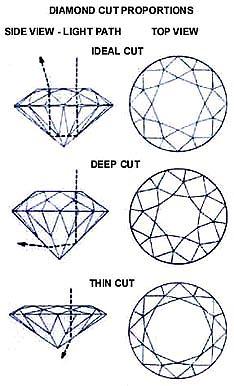
The diagram to the left aptly shows what happens when a Diamond is Cut ideally, Vs. what happens when the stone is not Cut well.

The top picture shows an Ideal Cut Diamond - you can clearly see that the light entering the Diamond is reflected from one facet to another and eventually is reflected back through the top of the stone in its entirety resulting in a brilliant, sparkly Diamond.
The middle diagram shows what happens when a Diamond is cut too deep. Much of the light entering the top of the Diamond escapes through the side of the stone (pavilion), resulting in a less than sparkling stone.
The last scenario is the shallow, or thin Cut stone. What happens when a Diamond is cut too shallow is that the light entering the top of the stone escapes through the pavilion before it can be reflected back through the top (table) of the Diamond.


Diamond Cut

0
A Diamonds Cut has perhaps the most profound effect over how a Diamond sparkles (refracts light).
How each individual stone is Cut has an incredible effect on the fire & brilliance of the Diamond, with an Ideal Cut (sometimes also referred to as European Cut) being the best Cut grade available and one which completely maximizes the sparkle, fire and brilliance.
Generally speaking, the further down the Cut scale you venture the duller the Diamond appears.
The main Cut classes are as follows:
Ideal
Excellent
Very Good
Well Cut
My next post will break down each cut "class" and hopefully offer at least some insight into Diamond Cut.

How Does Clarity Effect The Appearance Of A Diamond? (Cont.)

0
This post will in some ways introduce the Cut of a Diamond into the equation, a subject to be covered soon.

Whilst
Cut is the major influencing factor determining how bright a Diamond appears, even an Ideal Cut Diamond that has notable inclusions or imperfections can have a duller appearance than a less well cut stone with very good Clarity.

Put very simply, certain inclusions could have a negative effect upon how light is refracted and diffused once it has hit the Diamond. Any questions?
Email me.